

Drug & Substance Guide
Behavioral Addiction Treatment
Admissions answered 24 hours a day · Free and confidential
Excellent 4.6 out of 5 434 Google reviews across our locations



What clients say
Trusted by clients across Texas
4.6 from 434 Google reviews across 9 locations
Across Nova Recovery Center, Briarwood Detox Center and Eudaimonia Recovery Homes
★★★★★
“Nova is far from perfect, and some of the information can be misleading. But if you want to cover the 12 Steps while enjoying good food and a beautiful scenic view, this is the place for you. The…”
10 months ago · Wimberley
★★★★★
“I did 90 days at Nova Recovery 6 years ago. I am still sober today. And living a life I could have never imagined. The people and the program they are running impacted me for a lifetime. Better than…”
2 years ago · Wimberley
★★★★★
“I went to Nova almost 9 months ago and I wouldn’t change it for the world. The staff when I first entered were very nice and welcoming. As a 19 year old that didn’t know what I was getting myself…”
2 years ago · Austin
★★★★★
“Nova Recovery Center has been an invaluable part of my journey to sobriety. The intensive inpatient program, coupled with the unwavering support and guidance from my recovery specialist, Mark Rector…”
2 years ago · Austin


★★★★★
“I had such a positive experience at Nova Recovery in Wimberley! The staff genuinely cares and went above and beyond to support me every step of the way. The peaceful setting made it easier to focus…”
a year ago · Wimberley
★★★★★
“I love Nova so freaking much. Nova has saved my life in more ways than one. I was hopeless and had no solution suffering from this disease. The staff there never gave up on me. I was the worst client…”
2 years ago · Austin
★★★★★
“I know Mark rector is non-binary however it saved my life and it did a good job with CPR and I don't know how aside from staying sober I could ever repay it thank you Mr or Mrs or whatever you're…”
8 months ago · Austin
★★★★★
“It's been a few years since I was a patient at Nova Recovery Center. Recently I have been reflecting on my time there and how incredibly grateful I am for the experience I had. I have been to 7 rehab…”
2 years ago · Austin


Exceptional standards, backed by credible organizations
Our affiliations and accreditations
Medically Reviewed

Behavioral Addiction Treatment Overview at a Glance
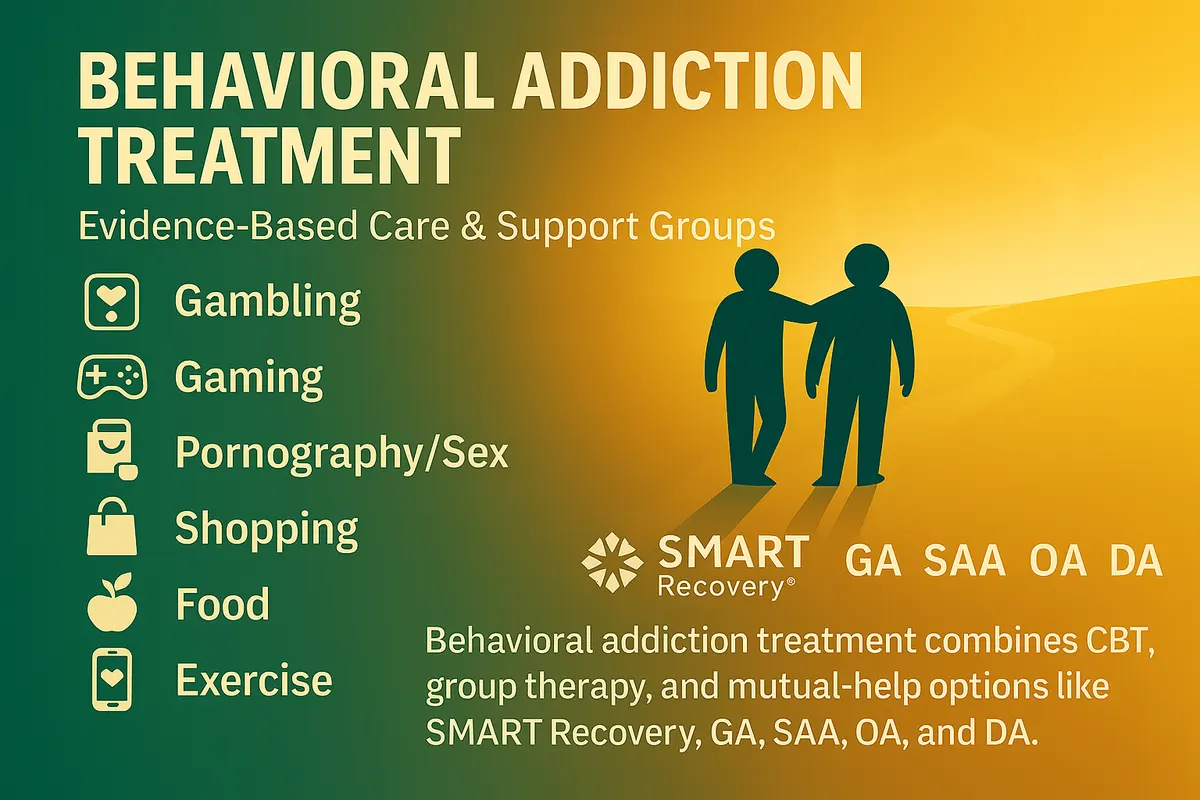
What it is: Compulsive, non-substance behaviors (e.g., gambling, gaming, sex, shopping, food, exercise) that continue despite harm.
Signs: Strong urges, failed attempts to cut back, secrecy, escalating time or intensity, and negative impacts on relationships, work, or finances.
Causes: Reward-learning in the brain, coping with stress or trauma, co-occurring mental health conditions, and easy access to triggers.
Treatment approaches: Evidence-based therapies like CBT, DBT, ACT, and Motivational Enhancement; group therapy; family involvement; relapse-prevention planning.
Support groups: SMART Recovery, GA, SAA, OA, DA, and online/local meetings offer accountability and skills between therapy sessions.
Levels of care: Outpatient, Intensive Outpatient (IOP), residential programs, and aftercare options tailored to severity and needs.
Behavioral addiction, and how it is treated
Behavioral addiction is treated with therapy rather than medication, because there is no substance to withdraw from. The pattern is compulsive gambling, gaming, sex, shopping, eating or exercising that continues after it has started costing you something, and it is treated mainly with cognitive behavioral therapy.
This page covers what a process addiction is, the common types, the signs worth acting on, how it is diagnosed, and the treatments with evidence behind them.
- Behaviors involved
- Gambling, gaming, sex, shopping, food, exercise
- Signs
- Strong urges, failed attempts to cut back, secrecy
- Therapies used
- CBT, DBT, ACT, motivational enhancement
- Levels of care
- Outpatient, IOP, residential, aftercare
Which level of care fits depends on severity. The admissions team will work that out with you on the call.
Where does the compulsion come from? Research suggests short‑term rewards (dopamine‑mediated) can reinforce behaviors in ways similar to substances, leading to diminished control and persistent use even when the person understands the consequences.
About the Author

Mat Gorman
Mat Gorman is an experienced mental health writer and medical researcher with over a decade of experience in addiction recovery education. He specializes in translating complex clinical topics into clear, compassionate content that empowers families and individuals seeking treatment. Mat has collaborated with recovery centers, licensed therapists, and physicians to publish evidence-based resources across the behavioral health space. His passion for helping others began after witnessing the struggles of loved ones facing substance use disorder. He now uses his platform to promote hope, clarity, and long-term healing through accurate, stigma-free information.










Common Types of Behavioral Addictions
Behavioral addictions can show up differently from one person to the next, but these categories capture common, impairing patterns:
- Gambling (including sports betting): mounting losses, “chasing,” secrecy, escalating stakes, and financial fallout.
- Gaming / Internet gaming: excessive hours, withdrawal‐like irritability when unable to play, neglect of school/work/relationships.
- Pornography / Compulsive sexual behavior: escalating time or intensity to get the same effect; failed attempts to cut back; shame and secrecy.
- Shopping / Spending: compulsive buying, debt, hiding purchases, and relief that is quickly replaced by anxiety or guilt.
- Food / Binge eating (noting overlap with eating disorders): loss of control episodes, using food to regulate emotions.
- Exercise / Work / Social media / Screen use: compulsive engagement despite injury, burnout, or social isolation.
It’s normal to enjoy games, shopping, or exercise. The issue is loss of control and harm, not the activity itself.
Signs & When to Seek Help
Ask yourself (or a loved one):
- Do urges or cravings dominate your thoughts?
- Do you need more time/intensity to get the same effect?
- Have you tried to cut back but can’t?
- Are you lying or hiding the behavior?
- Has it damaged relationships, finances, school, or work?
- Do you feel shame or regret, yet repeat the cycle?
If several are “yes,” a professional assessment is a smart next step.
Causes & Risk Factors
Behavioral addictions emerge from a mix of biology, psychology, and environment:
- Reward learning: short‑term relief or euphoria reinforces the habit loop.
- Coping gaps: behaviors used to numb or escape stress, loneliness, anxiety, or depression.
- Co‑occurring mental health conditions: treating anxiety, depression, or trauma can reduce urges and relapse risk.
- Access & triggers: phones, apps, casinos, or credit cards create “always‑on” cues.
- Family patterns & stressors: conflict, financial pressures, or isolation can keep the cycle going.

What it looks like:
- Functional analysis of high‑risk situations.
- Coping‑skills training (urge surfing, stimulus control, time budgeting).
- Financial safeguards (spending plans, accountability apps) for gambling/shopping.
- Relapse prevention planning (identify warning signs and “if‑then” scripts).

Group Therapy & Mutual Help
Group CBT and related formats are effective for a range of addictive behaviors and provide social reinforcement and skills practice in a supportive setting.
Mutual‑help options (free):
- SMART Recovery (secular, skills‑based; CBT‑informed): in‑person & online meetings and tools.
- 12‑Step Fellowships & alternatives: GA (Gamblers Anonymous), SAA (Sex Addicts Anonymous), OA (Overeaters Anonymous), DA (Debtors Anonymous), and non‑12‑step options (e.g., SMART) depending on preference.
- Digital self‑help: SMART’s web‑based Overcoming Addictions program demonstrates feasibility for skills‑based self‑management.
We accept most major insurance
Most major insurance covers treatment here
We'll check your benefits for free and tell you what you'd actually pay, before you commit to anything.
















Takes about 2 minutes · No obligation · Or call (512) 605-2955
Don't see yours? We work with more plans than we can show here.
VERIFY YOUR INSURANCE | 100% CONFIDENTIAL
Support Groups That Help (Online & Local)
Peer support adds accountability, hope, and practical tips between therapy sessions.
Find meetings now:
- SMART Recovery (skills‑based, CBT‑informed): Find a SMART meeting (online or in‑person).
- SMART meeting directory (US/Canada).
- Gamblers Anonymous (GA) and other 12‑step fellowships.
For comprehensive support options (including mental health and substance‑use groups), SAMHSA maintains a national support‑group and treatment locator.
Prefer alternatives to 12‑step? SMART is secular and evidence‑informed. Many people combine SMART with therapy for the best results.
Choosing the Right Level of Care
- Outpatient therapy1–2 sessions/week; good for early‑stage issues or after higher levels of care.
- Intensive Outpatient Program (IOP)9–15 hours/week of groups + individual work; adds structure and momentum.
- Residential Rehab / Inpatient Treatment24/7 support for safety, stabilization, and skill‑building when outpatient isn’t enough.
- Step‑down, Sober Living & aftercareongoing groups, peer support, and periodic therapy sessions prevent relapse.
Combining evidence‑based therapy with ongoing recovery support outperforms unstructured “willpower” alone.
Freedom Starts Here. Take Back Your Life Today.
Same-Day Admissions in Austin Available.
FAQs About Behavioral Addiction Treatment, Support Groups, and Evidence-Based Care
What’s the best therapy for behavioral addictions?
CBT leads the evidence base; group therapy improves outcomes and access. MET/DBT/ACT are helpful complements.
Can I recover without meetings?
Some do, but staying connected predicts better outcomes. Try SMART or a 12‑step option and decide after a few meetings.
Is gambling addiction a “real” addiction?
Yes; DSM‑5 lists Gambling Disorder in the addictions chapter.
How long until urges go down?
Many notice improvement within weeks of CBT and environmental changes; staying active in aftercare helps maintain gains.
Is medication necessary?
Not typically for the behavior itself, but it may help co‑occurring conditions. Your clinician will advise.
Are there alternatives to 12‑step?
Yes. SMART Recovery (secular, skills‑based) and other non‑12‑step groups.
What if I can’t afford therapy?
Start with SMART (free), explore FindTreatment.gov filters, and ask programs about sliding‑scale IOP/outpatient.
Do I need rehab (residential)?
Residential helps when safety, stability, or home triggers make outpatient hard; many succeed with IOP + community supports.
How do I help a loved one who denies there’s a problem?
Use motivational strategies, set boundaries, and consider a professionally planned intervention.

How Nova Recovery Center Can Help with Behavioral Addiction Treatment
At Nova Recovery Center, we recognize that behavioral addictions often appear alongside substance use disorders, creating a more complex recovery journey. Our team provides integrated treatment that addresses both the substance and the behavioral addiction together, ensuring no part of the cycle is overlooked. Through evidence-based therapies such as cognitive behavioral therapy (CBT), dialectical behavior therapy (DBT), and motivational enhancement, clients learn practical tools to manage urges and build healthier coping strategies.
We also incorporate group therapy and support group referrals, connecting clients with resources like SMART Recovery, Gamblers Anonymous, or Sex Addicts Anonymous for continued peer support. Our comprehensive care plans are personalized, offering outpatient, intensive outpatient (IOP), or residential levels of care depending on each client’s needs. For those with co-occurring behavioral addictions, family therapy and relapse prevention planning are central to long-term stability. With structured aftercare and alumni support, clients leave Nova Recovery Center prepared to maintain progress beyond treatment. By treating behavioral addictions as part of the full recovery picture, we help clients regain balance, strengthen relationships, and build lasting sobriety.
Get help today. Reach out now to start your path to healing.
Other Outpatient Drug and Alcohol Rehab Locations
- IOP in Austin
- IOP in San Antonio
- IOP in Colorado Springs
Keep reading
- Addiction Types: Substance Use Disorders vs. Behavioral Addictions (Complete Guide)
- Behavioral Addiction Help: Evidence‑Based Care, Types, Signs & Treatment
- Behavioral Addiction Support Groups: Find Online & Local Meetings
- Behavioral Addictions: Types, Signs, Causes & Evidence‑Based Treatment
- Causes of Behavioral Addictions: Risk Factors, Brain Science, and How to Lower Your Risk
Talk to someone today
Ready when you are
Admissions are answered 24 hours a day by a person, not a queue. We will check your benefits for free and tell you what treatment would actually cost.
Free and confidential · No obligation