
Drug & Substance Guide
Behavioral Addiction Support Groups: Find Online & Local Meetings
Admissions answered 24 hours a day · Free and confidential
Excellent 4.6 out of 5 434 Google reviews across our locations



What clients say
Trusted by clients across Texas
4.6 from 434 Google reviews across 9 locations
Across Nova Recovery Center, Briarwood Detox Center and Eudaimonia Recovery Homes
★★★★★
“Nova is far from perfect, and some of the information can be misleading. But if you want to cover the 12 Steps while enjoying good food and a beautiful scenic view, this is the place for you. The…”
10 months ago · Wimberley
★★★★★
“I did 90 days at Nova Recovery 6 years ago. I am still sober today. And living a life I could have never imagined. The people and the program they are running impacted me for a lifetime. Better than…”
2 years ago · Wimberley
★★★★★
“I went to Nova almost 9 months ago and I wouldn’t change it for the world. The staff when I first entered were very nice and welcoming. As a 19 year old that didn’t know what I was getting myself…”
2 years ago · Austin
★★★★★
“Nova Recovery Center has been an invaluable part of my journey to sobriety. The intensive inpatient program, coupled with the unwavering support and guidance from my recovery specialist, Mark Rector…”
2 years ago · Austin


★★★★★
“I had such a positive experience at Nova Recovery in Wimberley! The staff genuinely cares and went above and beyond to support me every step of the way. The peaceful setting made it easier to focus…”
a year ago · Wimberley
★★★★★
“I love Nova so freaking much. Nova has saved my life in more ways than one. I was hopeless and had no solution suffering from this disease. The staff there never gave up on me. I was the worst client…”
2 years ago · Austin
★★★★★
“I know Mark rector is non-binary however it saved my life and it did a good job with CPR and I don't know how aside from staying sober I could ever repay it thank you Mr or Mrs or whatever you're…”
8 months ago · Austin
★★★★★
“It's been a few years since I was a patient at Nova Recovery Center. Recently I have been reflecting on my time there and how incredibly grateful I am for the experience I had. I have been to 7 rehab…”
2 years ago · Austin


Exceptional standards, backed by credible organizations
Our affiliations and accreditations
Behavioral Addiction Support Groups Overview at a Glance
What a behavioral addiction is
Behavioral or process addictions involve compulsive engagement in rewarding behaviors such as gambling, gaming, pornography, overspending or compulsive eating, despite harmful consequences.
They are recognized clinically. Gambling disorder is the first behavioral addiction the DSM-5 lists alongside substance-related disorders, and the World Health Organization’s ICD-11 recognizes gaming disorder.
Those classifications matter for a practical reason: they guide assessment and care, and they confirm that help for this exists.
- What they are
- Compulsive behaviors continued despite harm
- First recognized
- Gambling disorder, in the DSM-5
- Also recognized
- Gaming disorder, in the WHO’s ICD-11
- Why that matters
- It guides assessment and care
A support group is often the right first step here rather than a program. Call and we will point you at one either way.










Why support groups work (the evidence in brief)
Support and mutual‑aid groups create connection, structure, accountability, and skills practice, key ingredients of recovery. Federal treatment guidance highlights group models (psychoeducational, skills, CBT/problem‑solving, and support) as effective components of care; mutual‑help groups also offer long‑term, low‑ or no‑cost support.
Bottom line: groups don’t replace therapy or medical care, but they reinforce change, reduce isolation and shame, and help people build a recovery routine that lasts.
The two big families of support groups
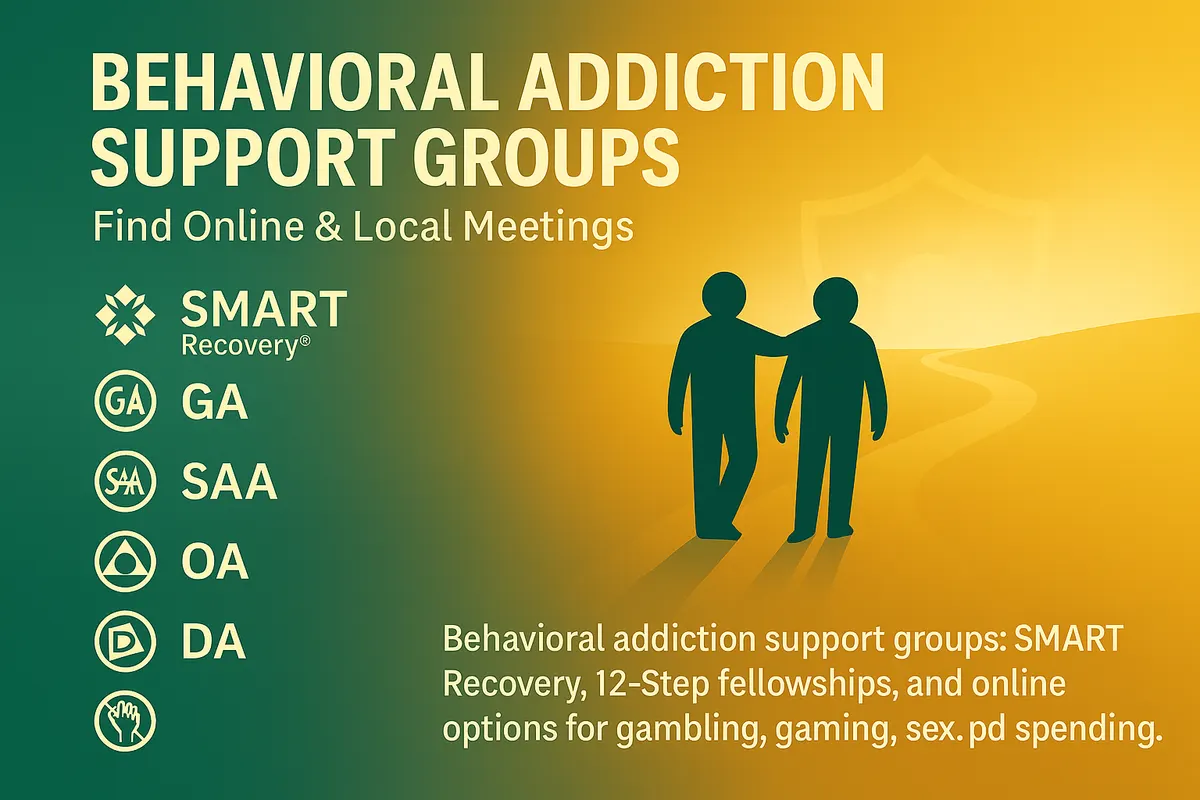
Find a meeting now: groups by behavior
Tip: Most meeting finders let you filter by online, phone, hybrid, or in person. Many groups ask newcomers to try six meetings before deciding whether it’s a fit.
What to expect at your first meeting
- Format & lengthmost SMART meetings run ~90 minutes with a check‑in, discussion/tools, and checkout; 12‑Step meetings are often 60–90 minutes with readings, shares, and optional newcomer introductions.
- Costfree, with optional voluntary donations.
- Participationyou can listen, sharing is optional for newcomers.
- Online accessmost fellowships offer Zoom/phone meetings; some provide attendance verification when required.
- Anonymity & safetymeetings emphasize respect, inclusivity, confidentiality, and avoiding triggering “war stories.”
We accept most major insurance
Most major insurance covers treatment here
We'll check your benefits for free and tell you what you'd actually pay, before you commit to anything.
















Takes about 2 minutes · No obligation · Or call (512) 605-2955
Don't see yours? We work with more plans than we can show here.
VERIFY YOUR INSURANCE | 100% CONFIDENTIAL

SMART vs. 12‑Step: which should you try?
Try both. Many people attend multiple formats before they decide. Here’s a quick comparison you can turn into a CTA box on your page:
- SMART Recoverysecular; focuses on cognitive‑behavioral tools and self‑management; uses worksheets, goal‑setting, and problem‑solving. Good if you want skills practice and a non‑spiritual frame.
- 12‑Step fellowshipsspiritual framework; sponsors; step work with a community. Good if you want a widely available global network and a spiritual program. (See GA, SAA/SLAA/SA, OA/FA/FAA, DA.)

Behavioral addiction 101 (context you can keep concise)
Gambling disorder is the best‑established behavioral addiction in DSM‑5; clinical guidance overlaps with substance use disorders.
Gaming disorder is included in ICD‑11 by WHO, which reinforces the value of peer supports for people whose gaming has become compulsive.
Support groups complement clinical care. If you suspect co‑occurring depression, anxiety, ADHD, trauma, or an eating disorder, pair groups with licensed care.
Step‑by‑step: join your first meeting this week
- Pick the behavior you want help with (gambling, gaming, sex/porn, spending, food, or “any addictive behavior”).
- Choose a formatSMART (secular) or a 12‑Step fellowship for your behavior.
- Filter by accessin‑person, online, or phone. (Most finders sort by time zone and language.)
- Show up and listen.You don’t have to speak. Bring a notebook and jot down one thing you’ll try before the next meeting.
- Try at least six meetings (different days/fellowships) to find your fit.
- Add a second lanetherapy, coaching, or a medical evaluation if you have safety concerns, withdrawal‑like symptoms, or co‑occurring conditions.
Online vs. in‑person: pros and cons
Online meetings are flexible, accessible, and can reduce barriers like travel, child care, or health risks; some people report weaker bonds or more distractions compared with in‑person groups. Hybrid options can help you do both.
Freedom Starts Here. Take Back Your Life Today.
Same-Day Admissions in Austin Available.
Family & partner support
Many fellowships include parallel groups for loved ones:
Gam‑Anon (for families/friends of gamblers).
S‑Anon (for families/friends of those with sex addiction).
FAQs About Behavioral Addiction Support Groups, SMART Recovery, and 12-Step Meetings
What are behavioral addiction support groups?
They are peer‑led or facilitator‑guided meetings for people working to change compulsive behaviors (e.g., gambling, gaming, sex/porn, spending, food). Formats include SMART Recovery (skills‑based) and 12‑Step fellowships. Meetings are usually free and available online or in person.
Do support groups actually help?
Yes. Group‑based approaches are a core part of evidence‑informed addiction care, providing social support, skills practice, and recovery structure that complement professional treatment.
What is the difference between a support group and group therapy?
Support groups are peer communities (often free) that share experiences and tools; group therapy is led by a licensed clinician using a treatment plan. Both can be used together.
What support groups exist for gaming addiction?
GAA, ITAA, and OLGA/OLGAnon host online and local meetings. The WHO recognizes gaming disorder in ICD‑11, which validates care‑seeking.
Are there support groups for pornography addiction?
Yes. SAA, SLAA, SA, PAA, and SPAA. Choose the one whose sobriety definition and culture align with your goals.
Where can I find gambling addiction meetings?
Gamblers Anonymous offers in‑person, virtual, and phone meetings (plus hotline 855‑2CALLGA). Families can attend Gam‑Anon.
What about food addiction or binge eating?
OA, FA, and FAA run meetings worldwide (in‑person and online).
Are meetings free?
Yes. Most are free and supported by voluntary donations to cover expenses.
What happens at a SMART Recovery meeting?
Expect a structured, 90‑minute session with check‑ins, discussion, and CBT‑style tools, facilitated by a trained leader.
Is it OK to attend online instead of in person?
Absolutely. Online meetings make recovery more accessible. Many people combine online during the week with an in‑person meeting on weekends.

How to choose the right group for you
- Match the behaviorpick a fellowship that speaks your language (GA vs. GAA vs. SAA/SLAA/SA vs. OA/FA/FAA vs. DA).
- Decide on frameworksecular SMART tools vs. spiritual 12‑Step. Try both early.
- Check accessonline, phone, hybrid, or nearby in person.
- Look for safetymeetings should emphasize anonymity, boundaries, and non‑judgment.
- Layer supportsif you carry trauma, depression, anxiety, ADHD, or an eating disorder, pair your group with therapy/medical care.
Accessibility & costs
Most groups are free and donation‑supported. Many provide virtual meetings; some offer attendance verification when required by courts or employers.

How Nova Recovery Center Can Help With Behavioral Addiction Support Groups
At Nova Recovery Center, we understand that behavioral addictions such as gambling, gaming, pornography, overspending, and compulsive eating can be just as disruptive as substance use disorders. Our comprehensive approach combines clinical treatment with connections to trusted behavioral addiction support groups, giving clients both professional guidance and peer accountability. We introduce individuals to options like 12-Step fellowships, and online or in-person meetings that fit their specific needs. By bridging structured therapy with peer support, we help clients build sustainable recovery routines and stronger support networks.
Our team also assists families in finding parallel support groups so loved ones can heal alongside those in recovery. Through education, relapse prevention strategies, and referrals to evidence-based mutual aid groups, Nova ensures that no one has to face behavioral addiction alone. This blend of professional care and ongoing community support helps clients stay engaged in recovery long after treatment ends. Ultimately, our goal is to empower each individual to live a healthier, more balanced life with confidence and connection.
Get help today. Reach out now to start your path to healing.
Other Outpatient Drug and Alcohol Rehab Locations
- IOP in Austin
- IOP in San Antonio
- IOP in Colorado Springs
Compliance & clinical note
This page is educational and not a substitute for medical advice. If you’re worried about safety (e.g., suicidality, severe withdrawal‑like symptoms, or acute medical/psychiatric risk), call 988 or seek emergency care now.
Keep reading
- Addiction Help: Understand the Effects, and Find Treatment That Works
- Addiction Resources: Helplines, Treatment Options, and Support Near You
- Addiction Types: Substance Use Disorders vs. Behavioral Addictions (Complete Guide)
- Behavioral Addiction Help: Evidence‑Based Care, Types, Signs & Treatment
- Behavioral Addiction Treatment
Talk to someone today
Ready when you are
Admissions are answered 24 hours a day by a person, not a queue. We will check your benefits for free and tell you what treatment would actually cost.
Free and confidential · No obligation