
Drug & Substance Guide
Causes of Behavioral Addictions: Risk Factors, Brain Science, and How to Lower Your Risk
Admissions answered 24 hours a day · Free and confidential
Excellent 4.6 out of 5 434 Google reviews across our locations



What clients say
Trusted by clients across Texas
4.6 from 434 Google reviews across 9 locations
Across Nova Recovery Center, Briarwood Detox Center and Eudaimonia Recovery Homes
★★★★★
“Nova is far from perfect, and some of the information can be misleading. But if you want to cover the 12 Steps while enjoying good food and a beautiful scenic view, this is the place for you. The…”
10 months ago · Wimberley
★★★★★
“I did 90 days at Nova Recovery 6 years ago. I am still sober today. And living a life I could have never imagined. The people and the program they are running impacted me for a lifetime. Better than…”
2 years ago · Wimberley
★★★★★
“I went to Nova almost 9 months ago and I wouldn’t change it for the world. The staff when I first entered were very nice and welcoming. As a 19 year old that didn’t know what I was getting myself…”
2 years ago · Austin
★★★★★
“Nova Recovery Center has been an invaluable part of my journey to sobriety. The intensive inpatient program, coupled with the unwavering support and guidance from my recovery specialist, Mark Rector…”
2 years ago · Austin


★★★★★
“I had such a positive experience at Nova Recovery in Wimberley! The staff genuinely cares and went above and beyond to support me every step of the way. The peaceful setting made it easier to focus…”
a year ago · Wimberley
★★★★★
“I love Nova so freaking much. Nova has saved my life in more ways than one. I was hopeless and had no solution suffering from this disease. The staff there never gave up on me. I was the worst client…”
2 years ago · Austin
★★★★★
“I know Mark rector is non-binary however it saved my life and it did a good job with CPR and I don't know how aside from staying sober I could ever repay it thank you Mr or Mrs or whatever you're…”
8 months ago · Austin
★★★★★
“It's been a few years since I was a patient at Nova Recovery Center. Recently I have been reflecting on my time there and how incredibly grateful I am for the experience I had. I have been to 7 rehab…”
2 years ago · Austin


Exceptional standards, backed by credible organizations
Our affiliations and accreditations


Medically Reviewed
Why behavioral addictions take hold
Behavioral addictions form the same way substance addictions do, which is why gambling, gaming, shopping and the rest can take hold without a drug in the picture.
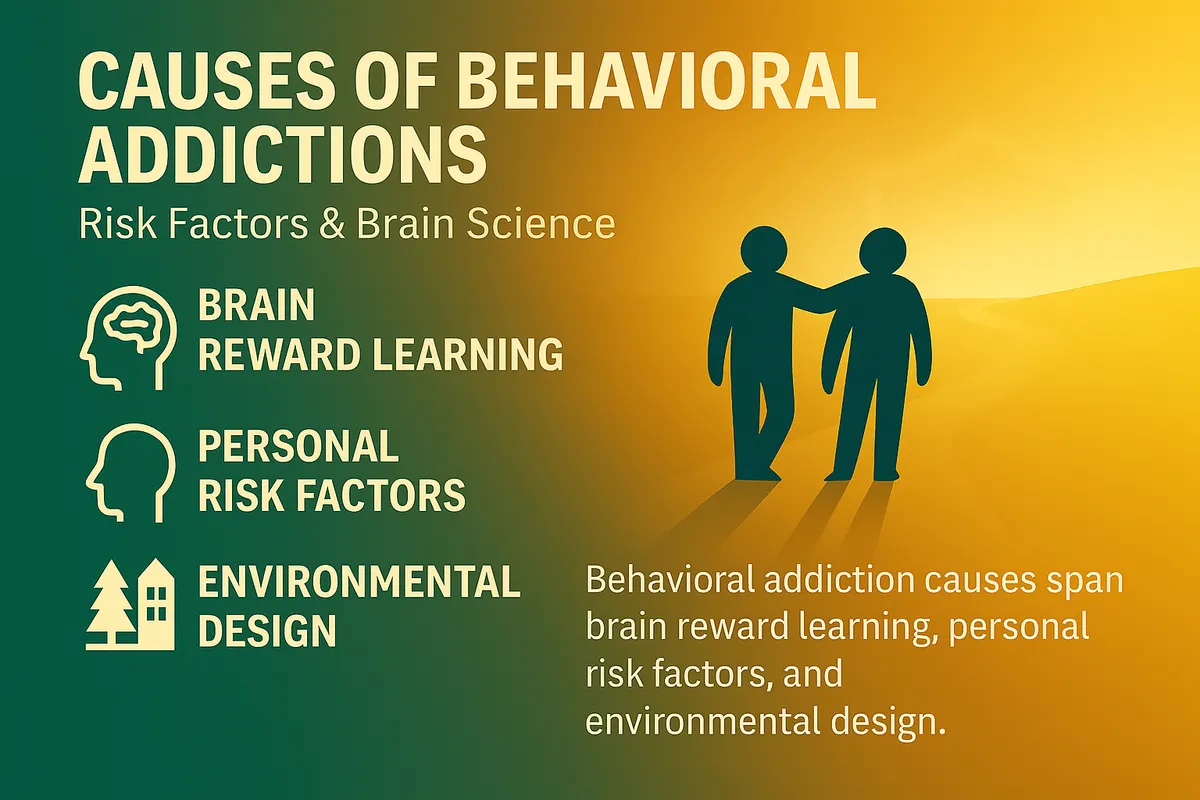
The reward system learns: dopamine and reinforcement learning make the behavior worth repeating. On top of that sit personal risk factors, including genetics and family history, ADHD, OCD, anxiety and depression, trauma and impulsive personality traits, and environmental ones, including how the products themselves are designed. This page covers what happens in the brain, the causes and risk factors one at a time, and what lowers the risk.
- The mechanism
- Dopamine and reinforcement learning
- Personal risk factors
- Genetics, ADHD, OCD, anxiety, depression, trauma
- Environmental triggers
- Persuasive design, variable rewards, constant access
- Most vulnerable
- Adolescents and young adults
These behaviors are designed to be hard to stop. That is a fact about the design, not a verdict on you.
Behavioral addictions (gambling, gaming and social media, sex and pornography, shopping, food and exercise, and smartphone overuse) don’t involve a drug. Yet the reasons people develop them look strikingly similar to the reasons people develop substance addictions: the same reward circuits, the same learning rules, and many of the same vulnerabilities.
At a high level, causes are layered:
- Brain learning that tags certain cues as must pursue now
- Personal risk factors (genes, mental health, traits, trauma, life stress)
- Environment and design that deliver rapid, variable rewards and constant access
Put these together and ordinary activities can harden into compulsive, harmful patterns.
Topic Information
Topic: Causes of Behavioral Addictions
Subject: Addiction Topics and Treatment
About the Author

Mat Gorman
Mat Gorman is an experienced mental health writer and medical researcher with over a decade of experience in addiction recovery education. He specializes in translating complex clinical topics into clear, compassionate content that empowers families and individuals seeking treatment. Mat has collaborated with recovery centers, licensed therapists, and physicians to publish evidence-based resources across the behavioral health space. His passion for helping others began after witnessing the struggles of loved ones facing substance use disorder. He now uses his platform to promote hope, clarity, and long-term healing through accurate, stigma-free information.










How behavioral addictions form in the brain
When you do something enjoyable, the brain releases dopamine in the reward pathway. Dopamine is not just “pleasure”; it’s learning and motivation. It stamps in the memory of what led to this reward so you repeat it. Over repeated cycles, the brain sensitizes “wanting” to the cues (notifications, app icons, casino sounds) so you crave the behavior even if the pleasure has faded. Studies in internet gaming disorder and other behavioral addictions show changes in reward processing consistent with this explanation.
Modern digital and gambling environments amplify the effect using variable reinforcement: the reward arrives unpredictably, sometimes small, sometimes big. This pattern causes faster learning and more persistent responding than steady, predictable rewards. It is a primary reason casino games, loot boxes, and infinite social feeds are so compelling.
Meanwhile, the prefrontal cortex (PFC), the area that handles planning and self‑control, tires under stress and sleep loss. As the PFC’s braking power dips, the habit loop (cue → routine → reward) runs with less oversight. Over time, people report the familiar cycle: tension before acting, pleasure/relief during the act, and loss of control despite consequences.
Core causes and risk factors
Why specific behaviors become addictive
We accept most major insurance
Most major insurance covers treatment here
We'll check your benefits for free and tell you what you'd actually pay, before you commit to anything.
















Takes about 2 minutes · No obligation · Or call (512) 605-2955
Don't see yours? We work with more plans than we can show here.
VERIFY YOUR INSURANCE | 100% CONFIDENTIAL

Who is most at risk? Patterns to watch
- Teens/young adults in high‑exposure environments (gaming, social media, online betting)
- People with family history plus co‑occurring ADHD/depression/anxiety/OCD
- Individuals with trauma/ACEs, high stress, or low social support
- High impulsivity/sensation seeking with easy access and few limits
Watch for: increasing time/money, secrecy, chasing losses, missing sleep/work, failed cutbacks, and distress when blocked.
Freedom Starts Here. Take Back Your Life Today.
Same-Day Admissions Available.
FAQ: Causes of Behavioral Addictions
What causes behavioral addictions in the first place?
A mix of brain reward learning, personal vulnerabilities (genetics, mental health, traits), and environmental design (variable rewards, easy access).
Are behavioral addictions genetic?
Genetics contribute to vulnerability, but they’re not destiny; environment and coping habits still matter. Family history raises risk.
What role does dopamine play?
Dopamine teaches the brain which cues predict rewards, increasing wanting even if liking fades, seen in internet gaming and other behavioral addictions.
Can anxiety or depression cause behavioral addictions?
They don’t cause them directly, but these conditions increase risk, partly because rewarding activities can become coping strategies.
Why are video games and social media so addictive?
They bundle unpredictable rewards, social validation, progress loops, and novelty, a high‑potency recipe for reinforcement.
Do teens have a higher risk, and why?
Yes. Youth show stronger reward sensitivity and weaker impulse control, and heavy screen/gaming environments amplify risk.
Can trauma lead to a behavioral addiction?
Trauma and adverse childhood experiences are well‑recognized risk factors because people may use behaviors to regulate distress.
Are behavioral addictions real if not in the DSM?
Clinicians recognize several behavior‑based disorders (e.g., gambling disorder) and behavioral addictions share mechanisms with substance addictions. Labels vary, but the impairment is real.
What are the biggest environmental causes?
Variable rewards, 24/7 access, persuasive design, and peer modeling. Reducing exposure and friction lowers risk.
How can you prevent a behavioral addiction from developing?
Track triggers, cap exposure, improve stress coping and sleep, treat co‑occurring conditions, and seek help early.

How Nova Recovery Center Treats Substance Abuse with Co-Occurring Behavioral Addictions
When substance abuse is the primary concern, it’s common for behavioral addictions to develop alongside as secondary diagnoses. At Nova Recovery Center, we take an integrated approach that addresses both conditions together, recognizing that the same underlying causes (such as trauma, mental health challenges, impulsivity, or environmental triggers) can fuel both substance use and compulsive behaviors. Our evidence-based therapies, including cognitive behavioral therapy (CBT) and relapse prevention training, help clients identify the connections between their substance abuse and behavioral patterns.
By treating co-occurring issues within the same program, we reduce the risk of one addiction fueling the other and strengthen long-term recovery outcomes. Clients receive individualized care plans that account for both substance abuse and behavioral addictions, supported by group therapy, educational workshops, and accountability within a structured recovery community. This holistic, comprehensive model ensures that every client learns healthier coping strategies while addressing the root causes driving addictive behavior.
With consistent support and a continuum of care, Nova Recovery Center helps individuals break free from destructive cycles and build a sustainable path to lasting sobriety.
Get help today. Reach out now to start your path to healing.

Sources
- Grant & Potenza et al., Introduction to Behavioral Addictions (overview of behavioral vs substance addiction mechanisms).
- Alavi et al., Behavioral Addiction vs Substance Addiction (similarities in reward pathways and clinical features).
- Santangelo et al., Risk Factors for Addictive Behaviors: A General Overview (genetic, psychological, environmental risk factors).
- Cleveland Clinic, Addiction: What It Is, Causes, Symptoms, Types & Treatment (authoritative clinical framing).
- Clark et al., Engineered highs: reward variability… (variable rewards increase addictive potential).
- APA Monitor, How gambling affects the brain and who is most vulnerable (youth vulnerability).
- Yen et al., catechol‑O‑methyltransferase & IGD (dopamine mechanisms in gaming).
- Zhang et al., Outcome assessment of different reward stimuli… (reward sensitivity imbalances as a cause).
Other Outpatient Drug and Alcohol Rehab Locations
- IOP in Austin
- IOP in San Antonio
- IOP in Colorado Springs

Medical Disclaimer
The information provided on this page is for educational purposes only and should not be considered a substitute for professional medical advice, diagnosis, or treatment. Behavioral addictions and related conditions require proper evaluation by a qualified healthcare provider. If you have concerns about your mental health, addictive behaviors, or treatment options, consult a licensed professional before making any changes. If you are experiencing a medical or psychiatric emergency, call 911 in the United States or seek immediate medical attention. For confidential mental health support, you can also dial 988 to connect with the Suicide & Crisis Lifeline, available 24/7.

Nova Recovery Center Editorial Guidelines
By instituting a policy, we create a standardized approach to how we create, verify, and distribute all content and resources we produce. An editorial policy helps us ensure that any material our writing and clinical team create, both online and in print, meets or exceeds our standards of integrity and accuracy. Our goal is to demonstrate our commitment to education and patient support by creating valuable resources within our realm of expertise, verifying them for accuracy, and providing relevant, respectful, and insightful data to our clients and families.
Keep reading
- Addiction Symptoms: How to Recognize the Signs in Yourself or a Loved One
- Behavioral Addictions: Types, Signs, Causes & Evidence‑Based Treatment
- Addiction Types: Substance Use Disorders vs. Behavioral Addictions (Complete Guide)
- Overcoming Behavioral Addictions: Effects, Symptoms & Recovery Guide
- Addiction Effects: Short‑ & Long‑Term Impact on Health, Brain, and Life
Talk to someone today
Ready when you are
Admissions are answered 24 hours a day by a person, not a queue. We will check your benefits for free and tell you what treatment would actually cost.
Free and confidential · No obligation